Newborn & Infant Vision Development
Newborns don’t have clear vision from day one. Vision develops gradually over the first months of life, and what your baby sees early on is very different from adult vision.
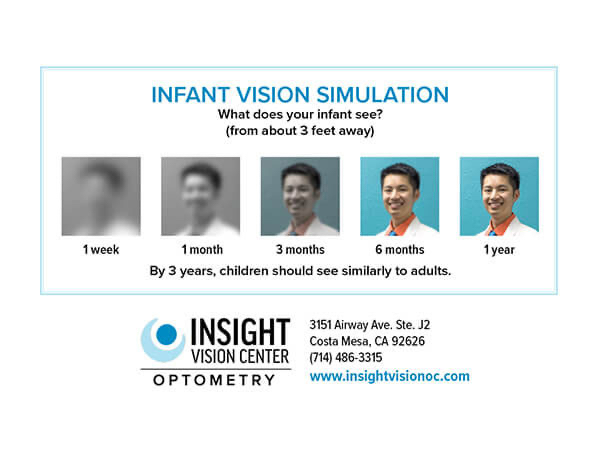
Quick Table
| Age | What Baby Can See | Focus Distance | Color Vision | Typical Behaviors |
|---|---|---|---|---|
| Birth – 2 weeks | Very blurry shapes, light vs dark | 20–30 cm (8–12 in) | None (grayscale) | Briefly looks at faces, prefers high contrast |
| 2–4 weeks | Slightly clearer outlines | 20–30 cm | Black, white, beginning contrast | Starts tracking slow movement |
| 1–2 months | Faces clearer, moving objects | 30–45 cm | Begins seeing red | Social smiling, eye contact |
| 2–3 months | Much sharper vision | Up to ~60 cm | Red, yellow, green | Smooth tracking, watches hands |
| 3–4 months | Good clarity at near & mid-range | 60–90 cm | Most colors | Better eye coordination |
| 4–6 months | Near-adult sharpness (still improving) | Across room | Full color | Reaches accurately, recognizes faces |
| 6–9 months | Depth perception develops | Near & far | Full color | Crawling, visually guided movement |
| 9–12 months | Close to adult vision | All distances | Full color | Precise hand-eye coordination |
Key Things to Remember
- Newborns see best at feeding distance (your face ❤️)
- Vision develops with the brain, not just the eyes
- High-contrast patterns (black/white/red) are most stimulating early
- Distance vision matures last
When to mention to a pediatrician
- No eye contact by ~8 weeks
- Poor tracking by ~3 months
- One eye consistently turning in/out
White noise
White noise is generally safe for babies and is commonly used to calm crankiness and help with sleep
✅ Why white noise helps
- Mimics womb sounds (whooshing, heartbeat-like noise)
- Masks sudden sounds that can startle babies
- Helps babies self-soothe when overtired or overstimulated
- Especially useful during the newborn / 4th-trimester phase
Many NICUs even use controlled white noise for premature babies.
⚠️ Safety rules you should follow (important)
🔊 Volume
- Keep it ≤ 50 dB (roughly the sound of a soft shower or quiet rain)
- If you have to raise your voice to talk over it → it’s too loud Tip: On phones/apps, use ~25–30% volume max.
📍 Distance
- Place the sound source at least 1–2 meters (3–6 ft) away
- Never inside the crib or right next to baby’s ears
⏱ Duration
- Safe to use during naps and nighttime sleep
- You don’t need it 24/7
- It’s okay if baby sometimes sleeps without it
🎵 Type of sound
Best:
- White noise
- Pink noise
- Rain, fan, womb sounds Avoid:
- Music with lyrics
- Sudden changes in volume
- High-pitched or sharp sounds
❌ Common myths (quick debunk)
- “It damages hearing” → only if too loud or too close
- “Baby will get addicted” → babies don’t form dependence the way adults do
- “Silence is better” → total silence actually makes babies more sensitive to noise
💤 When white noise is especially helpful
- Evening witching hours
- During overtired meltdowns
- Noisy environments (siblings, traffic, visitors)
- Helping baby transition between sleep cycles
👶 Signs you should adjust or stop
- Baby startles or cries more when it turns on
- Baby seems agitated instead of soothed
- You notice ear-covering or discomfort If that happens: lower volume or try a different sound.
Bottom line
✔ Safe ✔ Helpful ✔ Widely recommended ⚠️ As long as volume + distance are right
Colicky baby
A colicky baby is an otherwise healthy infant who has frequent, intense, and unexplained crying that seems impossible to soothe — even though they’re fed, clean, and comfortable.
It’s exhausting, confusing, and very common. And importantly: it’s not your fault ❤️
👶 What exactly is colic?
Doctors usually define colic using the “Rule of 3”:
Crying for more than 3 hours a day, more than 3 days a week, for more than 3 weeks in an otherwise healthy baby.
Colic typically:
- Starts around 2–3 weeks
- Peaks at 6–8 weeks
- Improves by 3–4 months
- Almost always resolves on its own
😣 What does colic crying look like?
Colic cries are different from normal crying:
- Very high-pitched, intense, painful-sounding
- Baby may:
- Pull legs up
- Clench fists
- Arch their back
- Turn red in the face
- Happens often in the evening / night
- Baby is hard or impossible to soothe
🧠 Why does colic happen? (Theories)
There’s no single proven cause, but likely contributors include:
- Immature digestive system
- Gas and gut sensitivity
- Developing nervous system (overstimulation)
- Difficulty self-soothing
- Gut microbiome changes
Importantly: 👉 Colic is not caused by bad parenting
🛠️ What actually helps (sometimes)
No one thing works for all babies, but these often help:
✔️ Soothing techniques
- White noise or shushing
- Swaddling
- Gentle rocking or babywearing
- Warm baths
- Pacifier (if baby accepts)
✔️ Feeding-related tips
- Burp frequently
- Upright feeding position
- Slower feeds
- If breastfeeding: sometimes trial removing dairy (only with doctor advice)
- If formula-fed: doctor may suggest hydrolyzed formula
✔️ Probiotics
Some evidence supports Lactobacillus reuteri DSM 17938 for breastfed babies (always check with your pediatrician first)
🚩 When it’s NOT colic (get checked)
Call a doctor urgently if crying is accompanied by:
- Fever
- Poor feeding
- Vomiting (especially green or bloody)
- Blood in stool
- Lethargy
- Failure to gain weight
💛 A word for parents (important)
Colic is one of the hardest phases of early parenthood.
- It does not predict temperament
- It does not harm your baby long-term
- It will end
If you ever feel overwhelmed: 👉 Put the baby down safely, step away, breathe, 👉 Ask for help — this is not meant to be done alone.
Newborn Skull Development
- A newborn’s skull is made of multiple bone plates with soft gaps called fontanelles (soft spots).
- This design allows:
- Passage through the birth canal
- Rapid brain growth in the first 2 years
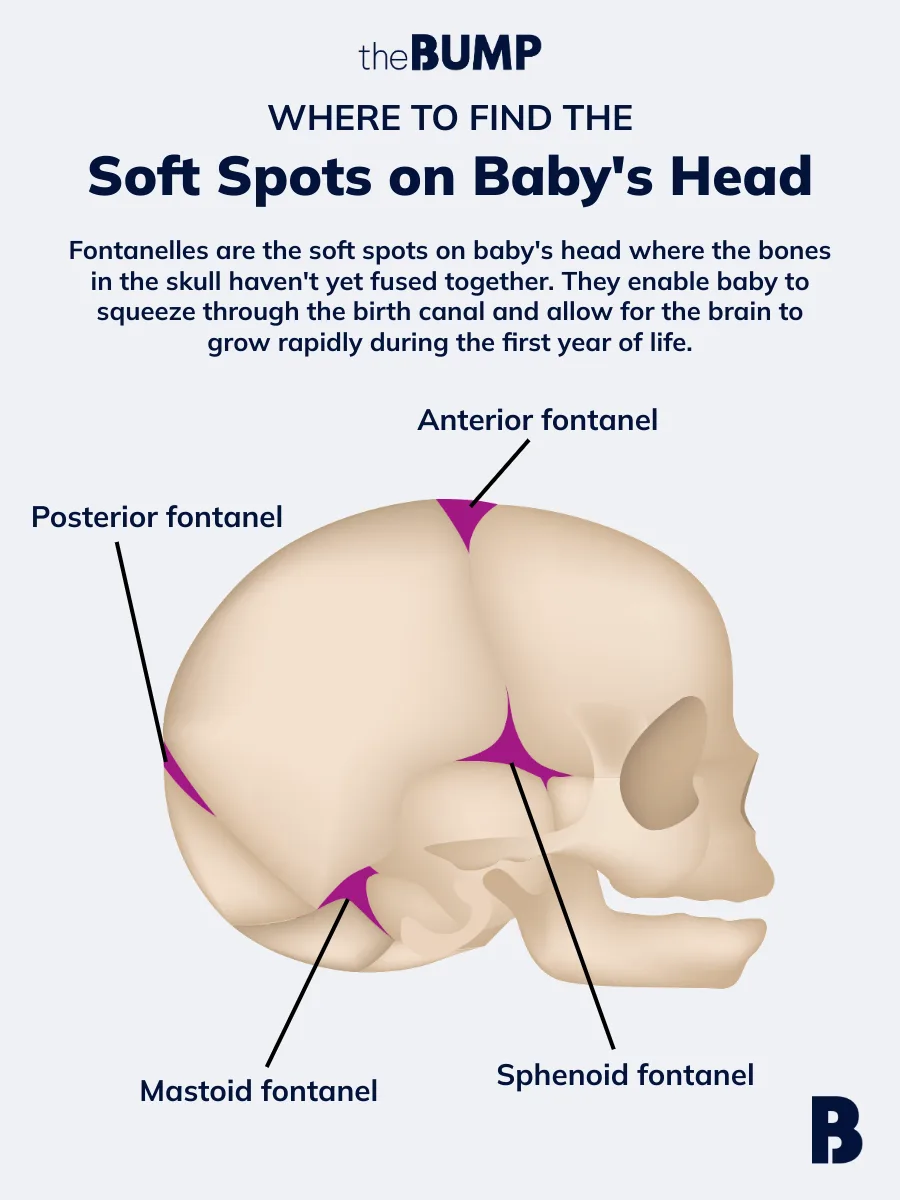
Skull Strength & Closure Timeline
- Birth–2 months: Skull is soft but well protected
- 2–6 months: Bones begin thickening
- 6–12 months: Skull becomes noticeably stronger
- 12–18 months: Posterior fontanelle closes
- 18–24 months: Anterior fontanelle closes → skull mostly solid
- 2–5 years: Skull bones continue fusing
- ~6–7 years: Near adult-level skull strength
Key Takeaways
- Soft does not mean fragile — the brain is protected
- Normal handling, touching, bathing, and cuddling are safe
- By 18–24 months, the skull is largely closed and strong
- Full strength develops gradually over several years
When to Check with a Doctor
- Soft spot bulges when baby is calm
- Soft spot appears deeply sunken
- Fontanelle closes very early (<6 months) or very late (>3 years)
- Uneven or abnormal head shape changes
Newborn Bathing Time – Summary
- There is no medically required time of day to bathe a newborn.
- Babies can be bathed any time of day if they are warm, calm, and supervised.
- Daily bathing is not necessary; 2–3 times per week is sufficient in the newborn stage.
Singapore-Specific Considerations
- Warm, humid climate → time of day matters less.
- Indoor air-conditioning is the main factor to manage.
- Avoid direct cold air on baby before and after the bath.
Comparing Bath Times
- Morning bath
- Baby more alert
- Less overtired crying
- Does not help with night sleep
- Late afternoon / early evening (4–6 pm)
- Often easiest and calmest
- Can fit into a gentle routine
- Evening bath (6–8 pm)
- May help relaxation for some babies
- May overstimulate colicky babies
- Late-night bath
- Not recommended
- Disrupts sleep, harder to keep baby warm
Practical Guidelines
- Choose a time when baby is fed (but not just fed) and calm.
- Keep room warm; avoid strong air-con.
- Water temperature ~ 37°C (body temperature).
- Bath duration: 5–10 minutes.
- Dry and dress baby immediately after.
Key Takeaways
- Consistency > clock time
- Pick a time you can repeat without stress
- Skip bath if baby is overtired or very cranky
Toys
Baby Toys 3-6 Months: The Only 7 Toys You Need
Source: YouTube
We don't need more toys, we need the right toys
Simple toys helps baby focus on the skill, not the distraction
Babies are obsessed with faces - especially their own
Best toy in the room is "YOU"!
- The Play Gym for reaching
- The “Free” Links Toy for transferring
- Plastic rings that usually come with play gym or other toys
- Oball for grasping
- Lightweight, squishy, full of holes, face saver on drops
- Rattles for cause-and-effect
- Light weight rattle with slam handles and avoid thick handles
- Teether for mouthing
- Lightweight, easy to clean toys
- Options: Teether: e.g., Sophie the Giraffe, Round rings, Drool
- Mirrors for tummy time
- Board Book for textures
- Not for reading, but for exposure. Textures for sensory feedback (e.g., rough and smooth), and Page turning
6 Sensory Toys & Activities for Baby Sensory Skills | Occupational Therapist Recommendations
Try avoiding electronic toys
e.g., bouncing bassinets, electronic swings, etc.
Source: YouTube
- High contrast visual toys/books/cards
- For visual perception skills
- Use during tummy time, sitting with lap instead of watching a movie or fast moving motion toys
- Vibrating Teether or Oral motor vibrating probe or O ball
- Provides stimulation to desensitise and push gag reflex back
- For oral, mouth and tongue exercises
- Therapy ball or Yoga ball
- To complete different movement activity
- Cause and effect toys
- Building Blocks with variety of textures
- Great for tactile system
- Blanket
- Blanket swing
- especially for colicky and cranky babies
- Vesticular stimulation
- Blanket swing