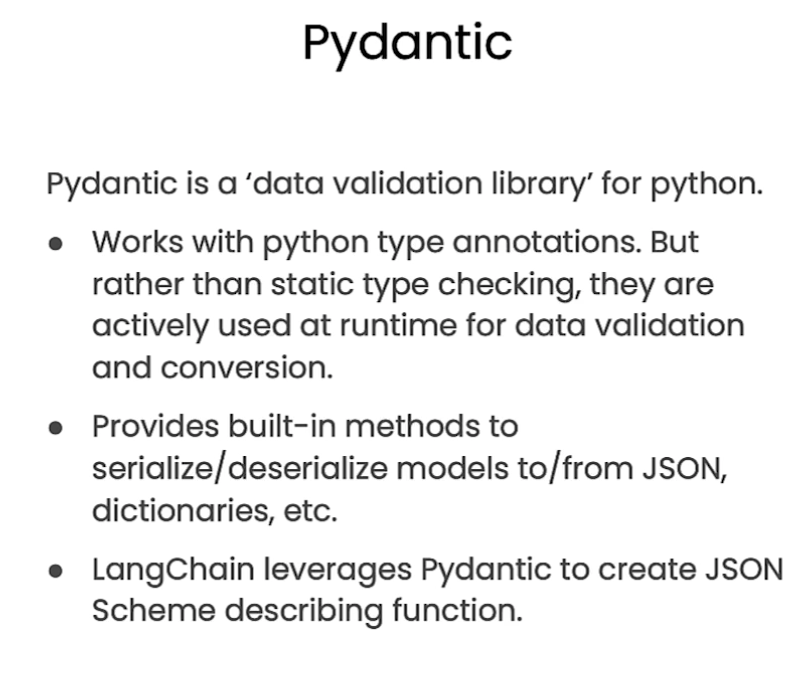
Mental model: Declare what your data should look like with Python type hints, and Pydantic enforces it at runtime — parsing, coercing, and raising clear errors automatically.
Why Pydantic
- Validation with zero boilerplate — Define a model and Pydantic handles validation, type coercion (e.g.,
"42"→42), and error messages - Serialization / deserialization —
.model_dump(),.model_dump_json(), and.model_validate()give clean dict/JSON round-tripping - Self-documenting data contracts — Models serve as living documentation for API payloads, config files, DB rows, etc.
- Custom validators —
@field_validatorand@model_validatorlet you add business logic that runs automatically on construction - Performance — Pydantic v2 rewrote the core in Rust (
pydantic-core), making validation 5–50x faster than v1 - Settings management —
pydantic-settingsloads config from env vars,.envfiles, or secrets directories with the same validation guarantees
BaseModel
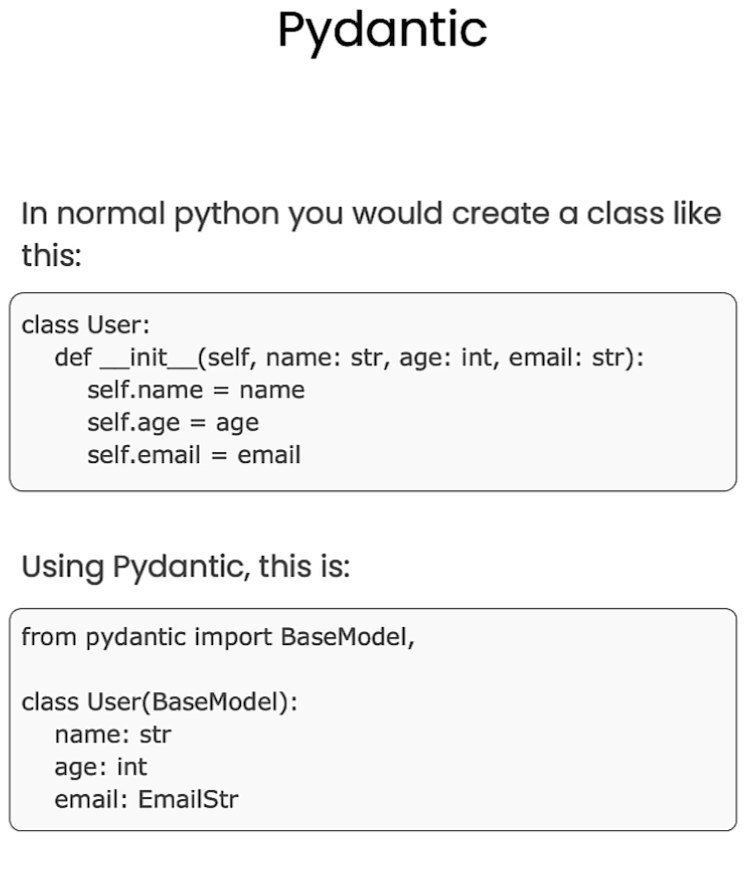
BaseModel is the core class all Pydantic models inherit from. It turns a plain Python class into a validated, serializable data structure — no __init__ needed.
A “model” is simply a class that inherits from BaseModel — it defines the blueprint of your data (what fields exist, their types, and any constraints). Same concept as a schema in JSON Schema, a model in Django ORM, or a struct in Go/Rust. The model_ prefix on methods (.model_dump(), .model_validate()) was added in v2 to avoid collisions with user-defined field names — v1 used .dict() and .json(), which broke if you had a field called dict or json. The model_ prefix makes collisions far less likely, though you should still avoid naming fields model_dump, model_validate, etc. as they would shadow the built-in methods.
What inheriting from BaseModel gives you:
| Feature | What it does | Example |
|---|---|---|
Automatic __init__ | Accepts fields as keyword arguments | User(name="Alice", age=25) — no def __init__ needed |
| Validation on construction | Fields are validated and coerced to their declared types | User(age="25") → age becomes 25 (int) |
.model_dump() | Convert model to dict | user.model_dump() → {"name": "Alice", "age": 25} |
.model_dump_json() | Convert model to JSON string | user.model_dump_json() → '{"name":"Alice","age":25}' |
.model_validate() | Create model from dict | User.model_validate({"name": "Alice", "age": 25}) |
.model_json_schema() | Generate JSON Schema from model | User.model_json_schema() → {"properties": {"name": ...}} |
Without vs With Pydantic
Without — manual validation is verbose and easy to forget:
class User:
    def __init__(self, name, age, email=None):
        if not isinstance(name, str):
            raise TypeError("name must be a string")
        if not isinstance(age, int):
            # Won't coerce "25" → 25, just rejects it
            raise TypeError("age must be an integer")
        if email is not None and not isinstance(email, str):
            raise TypeError("email must be a string")
        self.name = name
        self.age = age
        self.email = email
With Pydantic — same guarantees in 4 lines:
from pydantic import BaseModel

class User(BaseModel):
    name: str
    age: int
    email: str | None = None

user = User(name="Alice", age="25")
print(user.age)        # 25 (int, not str)
print(user.model_dump())
# {'name': 'Alice', 'age': 25, 'email': None}

User(name="Alice", age="not a number")
# ValidationError: 1 validation error for User
# age - Input should be a valid integer
BaseModel vs dataclass — Python's
@dataclassalso generates__init__from type hints, but stores whatever you pass with no validation.BaseModelvalidates and coerces on construction.
Examples
Nested Models
Pydantic automatically validates nested dicts into their corresponding model types:
from pydantic import BaseModel

class Address(BaseModel):
    street: str
    city: str
    country: str = "Singapore"

class Employee(BaseModel):
    name: str
    address: Address

emp = Employee(
    name="Bob",
    address={"street": "123 Orchard Rd", "city": "Singapore"}
)
print(emp.address.country)  # "Singapore"
Custom Validators
Two types of validators:
@field_validator— a@classmethodthat runs on a single field in isolation. Usescls(the class itself, not an instance) because the instance hasn’t been fully constructed yet. It’s for checks like “name must not be empty.”@model_validator— runs after all fields are set, so it usesself(the fully constructed instance) and can access the entire model. Use this when validation depends on multiple fields, like “end_date must be after start_date” (you need both values to check this).
from pydantic import BaseModel, field_validator, model_validator
from datetime import date

class Event(BaseModel):
    name: str
    start_date: date
    end_date: date

    @field_validator("name")          # only receives the name value
    @classmethod
    def name_must_not_be_empty(cls, v: str) -> str:
        if not v.strip():
            raise ValueError("Event name cannot be empty")
        return v.strip()

    @model_validator(mode="after")    # receives self — can access all fields
    def end_after_start(self) -> "Event":
        if self.end_date < self.start_date:
            raise ValueError("end_date must be after start_date")
        return self
Serialization Round-Trip
“Round-trip” means converting a model to JSON and back without losing data. This is useful when you need to store models in a database, send them over an API, or cache them to disk — you can always reconstruct the exact same model from the serialized output.
from pydantic import BaseModel

class Config(BaseModel):
    host: str
    port: int
    debug: bool = False

# Dict → Model → JSON → Model
config = Config(host="localhost", port=8080)
json_str = config.model_dump_json()
# '{"host":"localhost","port":8080,"debug":false}'

config2 = Config.model_validate_json(json_str)
assert config == config2
Settings from Environment Variables
Apps typically store config (database URLs, API keys, feature flags) in environment variables rather than hardcoding them. pydantic-settings lets you define a model for your config, and it automatically reads and validates values from env vars or .env files — so you get the same type safety for config as you do for data.
# pip install pydantic-settings
from pydantic_settings import BaseSettings

class AppSettings(BaseSettings):
    database_url: str
    api_key: str
    debug: bool = False

    model_config = {"env_prefix": "MY_APP_"}

# Reads MY_APP_DATABASE_URL, MY_APP_API_KEY, MY_APP_DEBUG
# from environment variables or .env file
settings = AppSettings()
Ecosystem and Use Cases
- FastAPI uses Pydantic models as its core request/response layer
- LangChain, Instructor, and OpenAI’s SDK use it for structured outputs (see Function Calling)
- Best applied at boundaries where untrusted or semi-structured data enters your code — API endpoints, file parsing, LLM outputs, config loading
JSON Schema for Function Calling
We create a Pydantic model that gets cast as a JSON schema, used for function calling in OpenAI.
The Pydantic model itself doesn't do anything — we just use it to generate the JSON schema.
For more details, refer Function Calling > OpenAISchema Powered by Pydantic section